Panel upgrades for an EV charger in Salt Lake City
A home Level 2 charger is one of the most common reasons Salt Lake City homeowners start looking at their electrical panel. It is not automatically a reason to replace that panel.
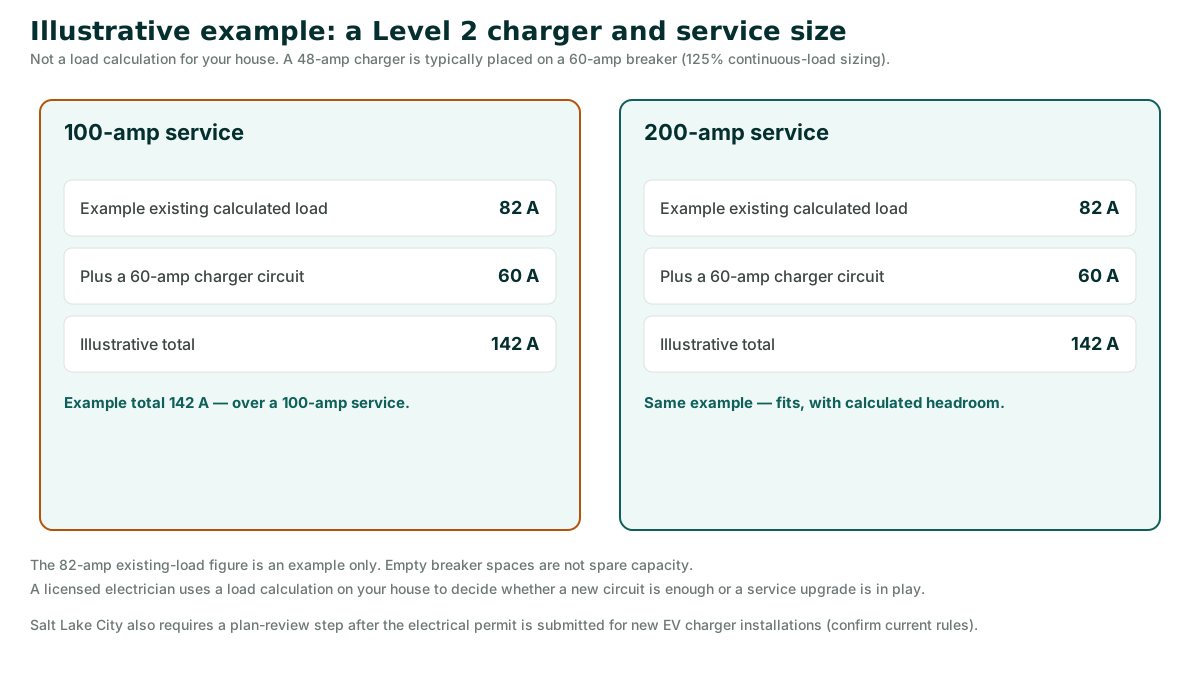
Why chargers stress older panels
A Level 2 charger typically runs on a 240-volt circuit and is treated as a continuous load under the National Electrical Code, which means the circuit is usually sized at 125% of the charger’s current rating. A 40- to 60-amp breaker is common. On a 60-amp or 100-amp service that already serves a range, dryer, and air conditioning, that is a large add. On a 200-amp panel with spare capacity, it may be a straightforward new circuit.
The only reliable way to tell is a load calculation based on your house and the equipment you plan to install — not the neighborhood, and not the main-breaker label alone.
Paths that are not always “upgrade to 200 amps”
- A new circuit on the existing panel if there is physical space and calculated capacity.
- A subpanel in a garage or addition when the main service already has enough amperage but not enough breaker spaces.
- Load management that shares capacity with other large loads, when the electrician and the equipment listing support it.
- A service upgrade, often to 200 amps, when the existing service cannot support the charger and the rest of the house together.
If the existing equipment is a fuse box or a Federal Pacific or Zinsco panel, replacement may be recommended for reasons that go beyond the charger.
City permits and plan review
Salt Lake City requires a permit to install or alter electrical systems. For new EV installations, Building Services also requires a plan review: after the electrical permit is submitted through the Citizen Access Portal, applicants submit a site plan, construction plans, and installation specifications to ProjectDox. That is in addition to the usual inspection. Details are on the city’s electrical fee and permit pages, which should be rechecked before you apply because processes change.
Cost context
The charger circuit and the panel upgrade are often priced as related but separate scopes. A panel or service upgrade in Salt Lake City is commonly described in published ranges around $2,000–$4,500+. The charger install itself is a different line item and is not estimated on this page. Ask for both scopes in writing if you need both.
Neighborhood notes for older 60-amp and 100-amp services: the Avenues, Sugar House, Capitol Hill, and Liberty Wells. Process details: permits and what to expect. If you are also adding a heat pump, see the heat pump guide.
Frequently asked questions
Do I automatically need a 200-amp panel to install a Level 2 charger?
No. A Level 2 charger is a large continuous load, and many 60-amp or already-full 100-amp services cannot absorb it. A 200-amp service is more likely to have room, but only a load calculation can say. Load-management equipment or a lighter charger rating can sometimes avoid a service upgrade.
Does Salt Lake City require a special review for EV chargers?
Yes. Building Services’ electrical fee page states that a plan-review process is required for all new electric vehicle installations. After you submit an electrical permit through the Citizen Access Portal, plans and installation specifications go to ProjectDox for review. Confirm the current packet with Building Services.
Is the charger permit the same as a panel-upgrade permit?
They can be related, but the scopes are different. Adding a charger circuit and changing the service are both electrical work that need a city permit. If both are happening, your electrician should make sure the application describes the full job. Do not assume one permit covers unlisted service-entrance work.
Will Rocky Mountain Power need to be involved?
If the existing service can support the charger and the meter stays in place, the utility may not need to disconnect anything. If the job includes a service upgrade or meter-base work, Rocky Mountain Power coordinates the disconnect and reconnect, and a city inspection is typically required first.
Request a quote
A local licensed electrician can look at your panel, service, and planned loads and give you a written scope. There is no obligation to hire anyone.